- Australia's Favourite Cycling Shop Since 2007


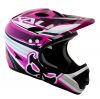
Savara Full Face Helmet - PINK - Size L - CLEARANCE
Brand
Kali
Savara Full Face Helmet - PINK - Size L - CLEARANCE
Savara Full Face Helmet - PINK - Size L - CLEARANCE
54


Details
Kali Savara Full Face Helmet
CLEARANCE Size L - Pink
Features:
- Tough to beat, the KALI SAVARA™ helmet sets the pace for introductory level full face downhill helmet protection.
- Fibreglass Shell with EPS liner
- Integrated Airflow System with 14 Vents: 7 Up Top & 7 around.
- Antibacterial, removable, washable liner
- Safety compliance: AUSTRALIAN STANDARDS APPROVED
Not only Kali Tough but Kali Light!! Only 920g for a Size M !
You will be hard pressed to find a lighter, safer helmet on the market!
Note actual item may differ slightly to image.
More Information
| Brand | Kali |
|---|---|
| Best Seller | No |
| media | PRODUCT REVIEW: KALI SAVARA FULLFACE HELMET by URBAN MILITIA on January 24th, 2013 The SAVARA Helmet is an introductory level full-face downhill helmet from Kali which features: Fiberglass shell with EPS liner, Integrated Airflow System with 14 Vents, Antibacterial, removable, washable liner, and passes the Safety compliance: EN 1078 or CPSC, ASTM F2040, ASTM F2032, ASTM F1952. It is very lightweight (which is approximately around 860 grams), and fit’s perfectly well on the head. The helmet also has an easy release plastic buckle wherein you can easily secure your helmet even while wearing gloves. The visor’s angle can easily be adjusted as well as the chin strap near the buckle. Wearing this helmet during the race felt like your just wearing expensive carbon full face helmet because it’s lightweight. Overall, Kali Savara full face is an excellent helmet choice for riders who are looking for quality, safe, and budget friendly headgear protection for downhill racing. My personal rate: 8.5 (out of 10) |
| Custom Tab Title | TECHNOLOGY |
| Custom Tab Content |
What is behind Kali's COMPOSITE FUSION™ technology? by Brad Waldron Engineer and Founder of Kali Bike Helmets "So many times when looking at a company’s claim I ask myself “Is this real or is this just salesman speak?”. I certainly can’t make up your mind for you, but I can tell you about our patented technology and why we are excited about it. A helmet has two essential elements that help protect you: a shell and energy absorbing foam. These two components are built to dissipate the energies of an impact to your head. The shell is the hard outer surface of a helmet and has 3 functions. First, it prevents sharp object penetration. Second, it protects the energy absorbing foam from abrasion. Lastly, it spreads out the force of an impact over a greater area. As the second component of the puzzle, the energy absorbing foam is the inner muscle of a helmet and the more active component of the two. It does the bulk of the work, cushioning and redirecting the G-forces of any impact that tries to work its way towards your head. Standard helmet technology constructs the shell (made from various composite materials) and the energy absorbing foam composite (Expanded PolyStyrene or EPS) as two separate pieces. Simply shooting small beads into a mold makes the EPS foam. The beads are then steamed, expanded and bound into the “generic” shape of the exterior shell. This “shaped” EPS form is then pulled from the mold and allowed to dry, and then inserted into the shell by hand (being spot glued or taped into place inside). This means that during an impact to the head, there will actually be a microsecond of ‘air’ as the energy is transferred between one protective material (the shell) and the next (the EPS foam). The result of this separate-but-glued-construction is a less efficient transfer of energy when a helmet is impacted. Another unfortunate consequence of standard helmet construction is that over time the glue joints may wear down, which leaves users with EPS foam that is loose inside the shell. In addition to being uncomfortable, it can also be potentially dangerous, as the EPS foam may not stay in its intended position during an impact." |
| Best Value Blurb | product |


Reviews